You know that 40 housings left the raw-material shelf and 20 kits appeared in finished stock. A month later, finance asks which production run connects them. Two adjustment entries show the quantities, but the relationship may live only in someone's memory.
A production record should explain what was made, what was consumed and how the two belong together. For a brand assembling goods in whole units, that is the difference between correcting two stock totals and recording the production activity itself.
Correct totals can still leave a missing explanation
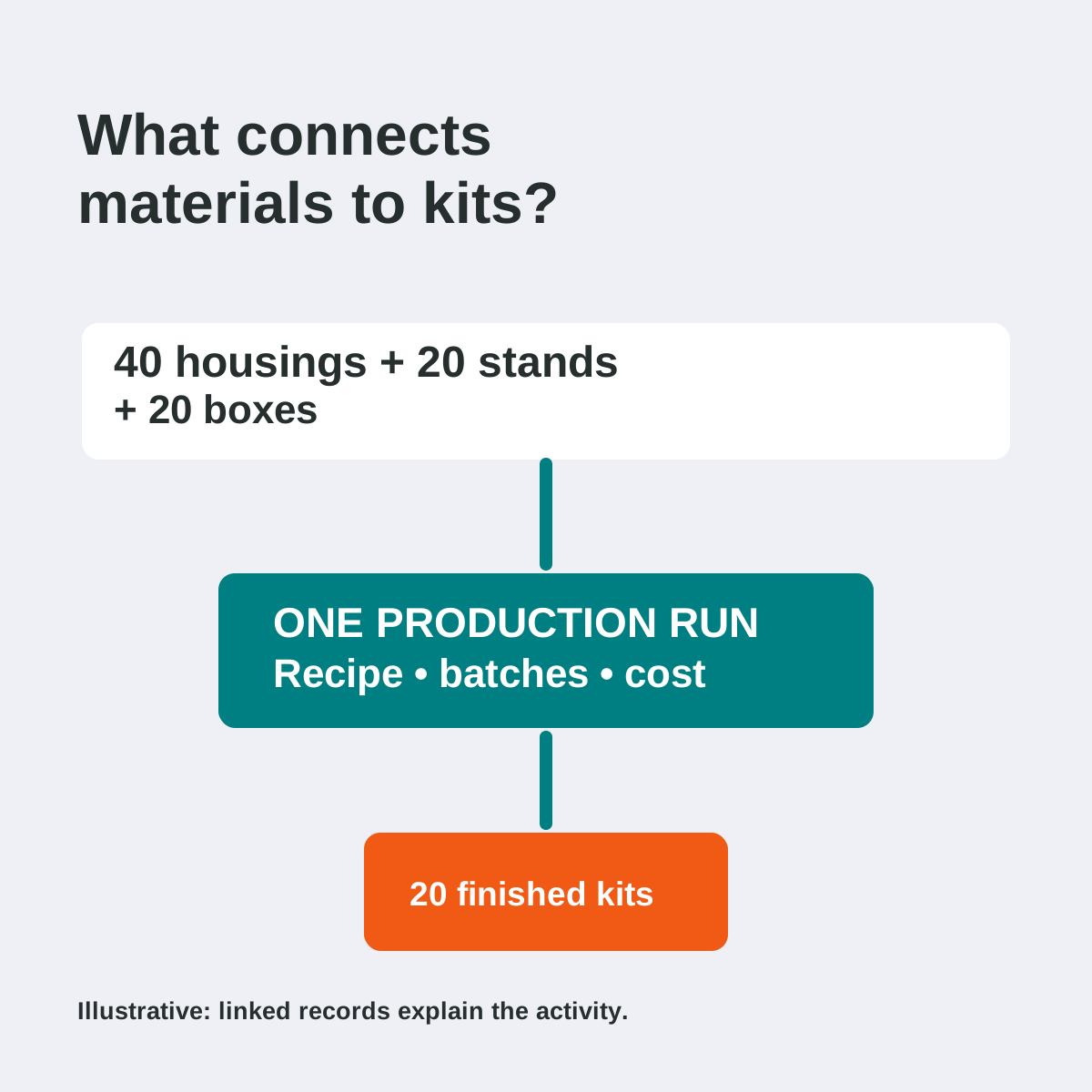
Suppose one finished display kit needs two housings, one stand and one packaging box. A run of 20 kits therefore needs 40 housings, 20 stands and 20 boxes. Each component is issued as a whole unit.
Separate adjustments can reduce those materials and increase the kits. If the records are not linked, the next person still needs to establish which recipe applied, whether the quantities describe the same run, and what happened if that run was cancelled or corrected.
A manual adjustment remains useful for a genuine stock correction. It should not be the only explanation of routine production when your business needs to trace materials to the finished goods they created.
The recipe and the run answer different questions
The bill of materials describes the planned components for the product. The production order identifies the particular run: its outputs, component requirements, source warehouse, destination warehouse and progress.
The distinction becomes practical when a component changes. A recipe version identifies the intended basis; a run record preserves what that production activity used. An owner investigating a questionable batch needs that link, rather than today's recipe alone.
GS1's traceability criteria address maintaining information links between inputs and outputs. That is the general traceability principle behind this discussion. It does not certify a particular software product or prove that your business meets a sector-specific standard.
Put the cost beside the quantities
For the example, suppose a housing costs ₹100, a stand ₹150 and a box ₹50. Component cost for one kit is 2 × ₹100 + ₹150 + ₹50 = ₹400. For 20 kits the component total is ₹8,000.
That explains the component-cost relationship; it is not a complete manufacturing profit calculation. Labour, overhead and other costs require their own agreed treatment. Do not call ₹400 the full cost of the kit merely because the materials reconcile.
HyperInventory supports BOM-linked production orders, whole-unit raw-material issue and finished-goods receipt, batch tracking on consumption and output, and component weighted-average cost roll-up at issue time. Supported accounting sync uses a manufacturing stock journal through Tally, BUSY or Zoho.
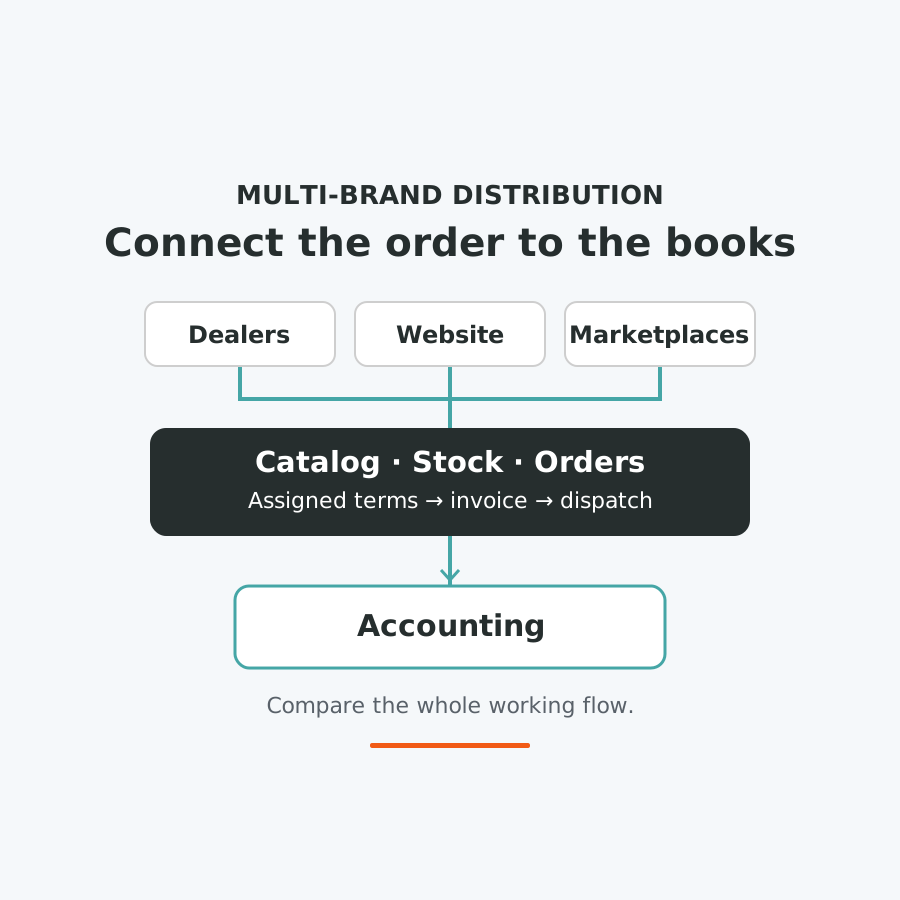
The useful connection for a commerce-led brand is that finished goods enter the stock used by its selling operations, while the materials and accounting record stay connected to the production run. There is no need to claim a new product release to explain this existing capability.
Ask for one traceable production run
Take one real whole-unit product into a demonstration. Keep this acceptance record:
- Product, active BOM version and intended output quantity.
- Expected component quantities and source warehouse; actual issues and batch references.
- Production-order reference and progress; destination warehouse and finished batch.
- Component cost basis and expected stock journal in the selected accounting connection.
- Completion result, remaining stock and the procedure for a full cancellation or reversal.
Have operations and finance follow the same reference. If one person can explain the materials but another must reconstruct the journal from unrelated adjustments, the handover is not yet complete.
This is an acceptance checklist, not a description of specific screens. Use a current demonstration to establish the exact interface and integration steps for your agreed implementation.
Know where this workflow fits
This is simple production for brands operating with whole-unit stock movements. Fractional issue or completion quantities, MRP, subcontracting, multi-stage routing and work centres are outside the supported scope described here. Completion is not split into partial tranches; discuss quantity changes and a separate order for the balance in your demonstration.
Those boundaries matter more than a long manufacturing feature list. A brand assembling saleable kits can test the relevant production-to-stock-to-books connection; a business needing process manufacturing or factory scheduling should evaluate those requirements separately.
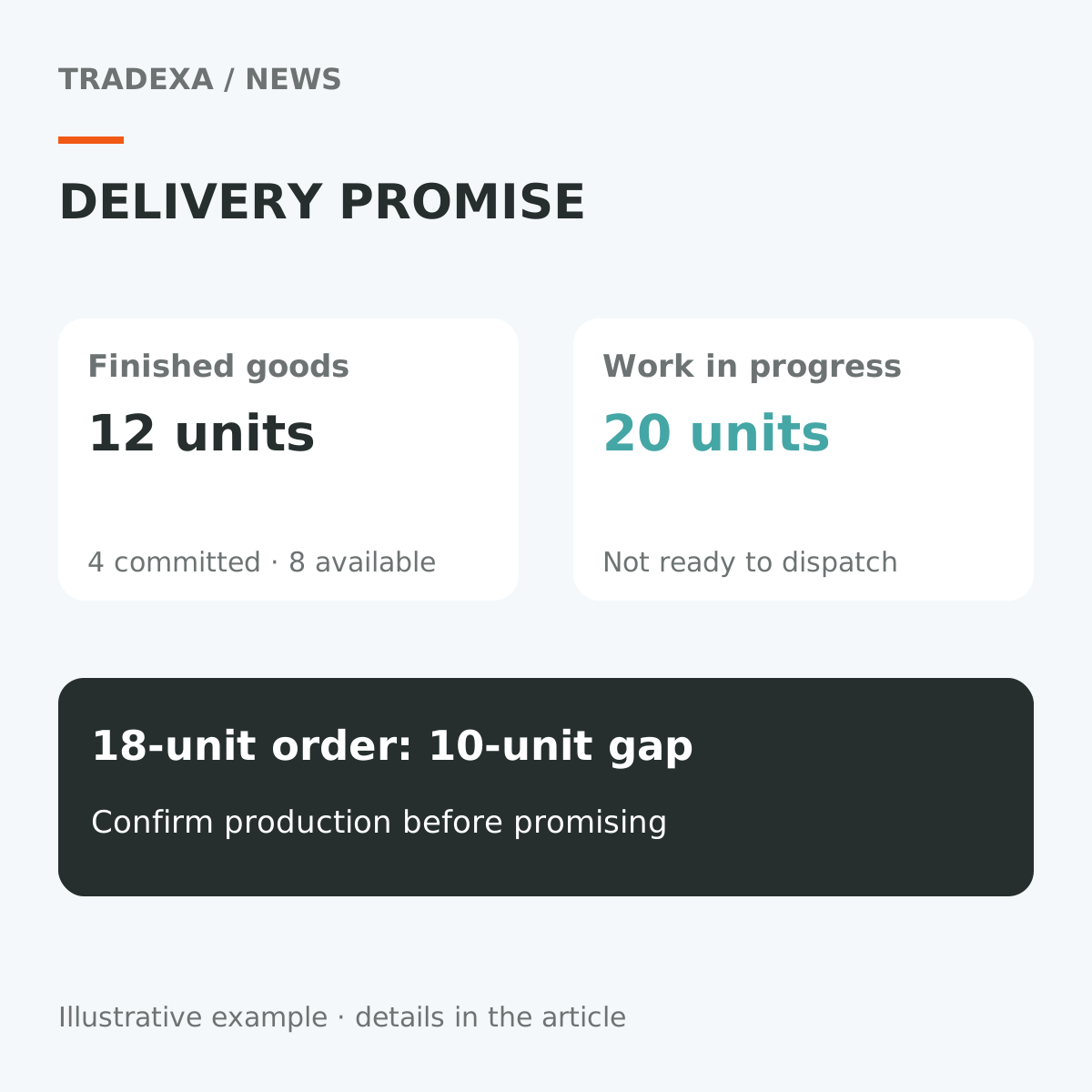
Clearer run records give the team a better basis for investigating a component problem, preparing the next supported batch and explaining finished stock to finance. They do not create demand or guarantee production capacity. Before accepting a customer date, also read finished stock versus work in progress.
Example note: the kit recipe and ₹8,000 component total are illustrative. They explain linkage and material cost, excluding labour and overhead.
Sources
- GS1 Global Traceability Compliance Criteria Standard, internal input/output information linkages; consulted 20 October 2026.