The website report closes on Sunday. The marketplace settlement arrives later. Dealer invoices include sales that have not yet been paid. Put those three totals beside one another and the biggest number may simply be the one counted differently.
Compare channels using the same sales period, the same cost definition and an explicit treatment of returns. Begin with contribution after directly attributable costs. Then examine the shared costs separately. A bank deposit, an invoice total and a contribution figure answer different questions.
A settlement is not the sales cohort
Choose the orders you want to study, such as September's fulfilled sales, and write the inclusion rule. Match their returns, discounts and selling costs back to that cohort wherever the data allows. Record the cut-off date and identify estimates that may change.
A late refund for an August sale should not quietly make September look worse while August retains all its original revenue. You can maintain an operational current-period view too, but label it differently from the cohort comparison.
For dealer credit sales, collection timing is a separate cash question. A paid marketplace order and an unpaid dealer invoice can have comparable contribution while presenting very different working-capital needs.
The apparent winner can change after matching costs
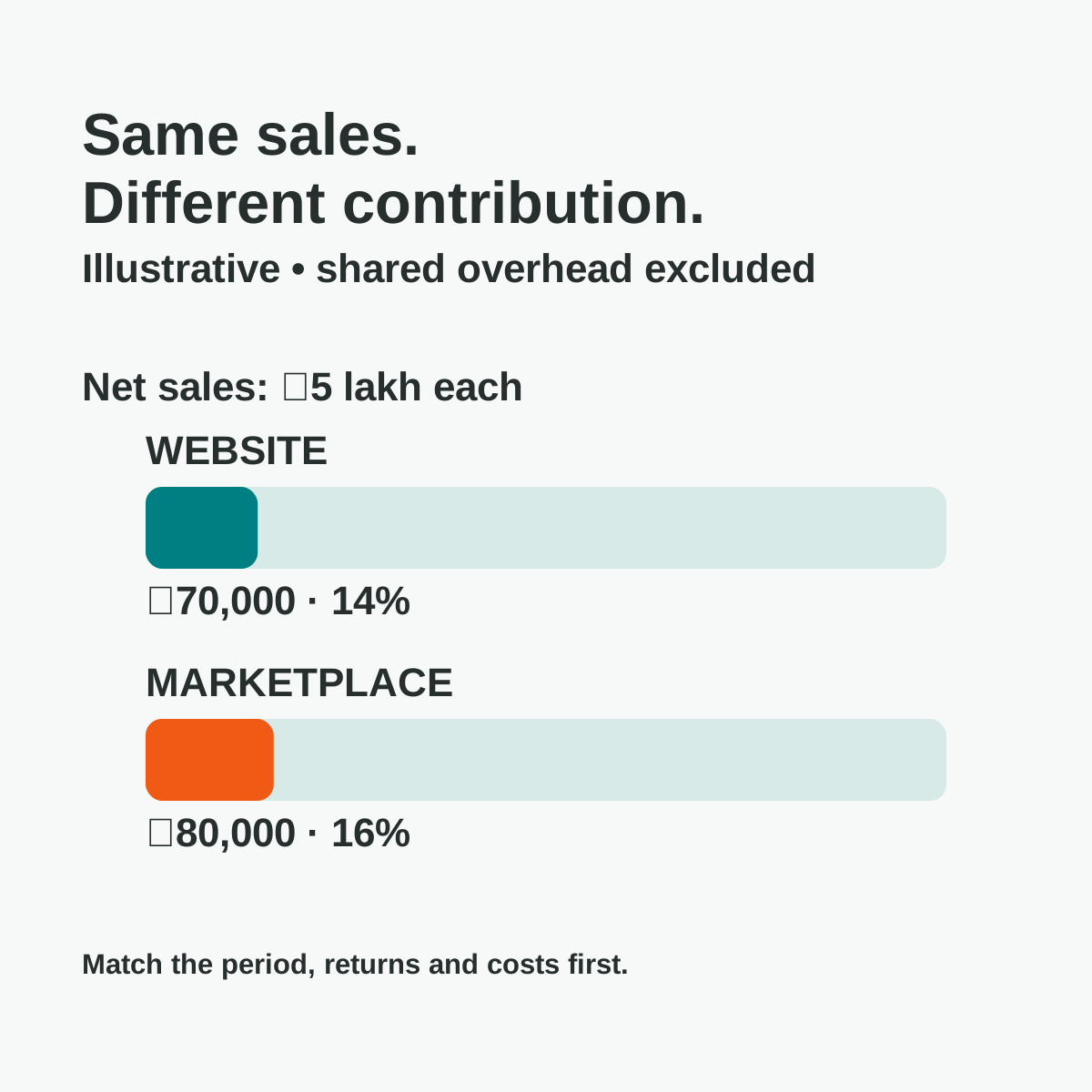
Suppose a brand compares one month's website and marketplace sales, excluding GST throughout. Each channel has ₹5 lakh of net sales after the matched refunds and discounts. Each has ₹3 lakh of product cost on the goods retained by customers, using the same cost method.
The website has ₹70,000 of directly attributable payment, packing, delivery and return costs, plus ₹60,000 of advertising assigned once under an agreed method. Its contribution is ₹5,00,000 − ₹3,00,000 − ₹70,000 − ₹60,000 = ₹70,000, or 14% of net sales.
The marketplace has ₹1,00,000 of directly attributable selling, fulfilment and return costs, plus ₹20,000 of assigned advertising. Its contribution is ₹80,000, or 16%. These are illustrative combined costs, not quoted marketplace fees.
A revenue-only comparison calls the channels equal. This contribution model shows a ₹10,000 difference for that cohort, before shared overhead. It still does not establish which channel deserves every future sale: product mix, stock, customer demand and cash requirements also matter.
Decide what belongs in each layer
Amazon's own seller guidance identifies product cost and several selling-fee categories in its profitability calculation, and notes that actual fees depend on factors including product and fulfilment choice. Use the actual applicable charges; do not copy one product's fee percentage across the catalogue.
Use one cost checklist for every channel: net revenue; product cost; channel/payment fees; fulfilment and return costs; discounts not already netted from revenue; and advertising under the agreed attribution method. Do not deduct a fee again if it is already included in a combined fulfilment figure.
Then show shared warehouse, head-office, software and service costs separately. An allocation may help management decisions, but write its basis. A channel can look less profitable simply because it receives more overhead under a changed allocation rule.
Call the first layer contribution, rather than final net profit. Agree with finance how taxes, recoverable amounts, inventory write-downs and shared costs belong in the actual reporting model.
Use a channel comparison record
Copy this record and complete it before discussing which channel to expand:
- Decision: product family and proposed range or capacity change.
- Cohort: order inclusion rule, sale dates and return/cost cut-off date.
- Revenue basis: tax treatment, cancellations, discounts and refunds.
- Cost basis: product-cost method and directly attributable fee/fulfilment/return categories.
- Advertising: attribution rule, time window and check that spend is counted once.
- Results: contribution in rupees and percentage; unresolved estimates; shared costs shown separately.
- Cash and next action: unpaid balances, settlement timing, stock needed and person checking the remaining uncertainty.
If unresolved returns could erase the difference between channels, postpone the irreversible range decision or run a smaller test. A provisional number should remain visibly provisional.
Use connected context to choose the next test
HyperInventory's connected reporting supports sales and stock across integrated channels, and the owner-verified analytics scope supports comparing channel performance and profitability. That context helps the owner and finance team investigate the same products across their selling routes. It does not remove the need to agree the cost and return basis of a particular comparison.
Where one channel earns stronger contribution on a product family and has demand, use the result to plan a bounded range or stock test. Check whether the warehouse and customer-service team can support it. The growth opportunity comes from that specific next decision, not from declaring a permanent channel winner.
For a deeper look at the costs inside one order, see what an order costs after the sale. For advertising decisions, use the separate guide to product margin before scaling ads.
Example note: the two-channel figures are illustrative contribution calculations. They exclude shared overhead and use a common tax-exclusive basis; they are not measured merchant results or current marketplace tariffs.
Sources
- Amazon India seller fees and pricing, fee categories and profitability calculation; consulted 20 October 2026. No listed fee rate is used in the example.