A supplier needs eight days to deliver, but your available stock covers fewer days than that. The useful question is when to review replenishment, and how much to order without ignoring stock already on its way.
Keep those two decisions separate. A reorder point tells you when to look at the item. The quantity you buy depends on the period you want to cover, commitments, incoming supply and the supplier's ordering rules.
Start with the units you expect to need before delivery
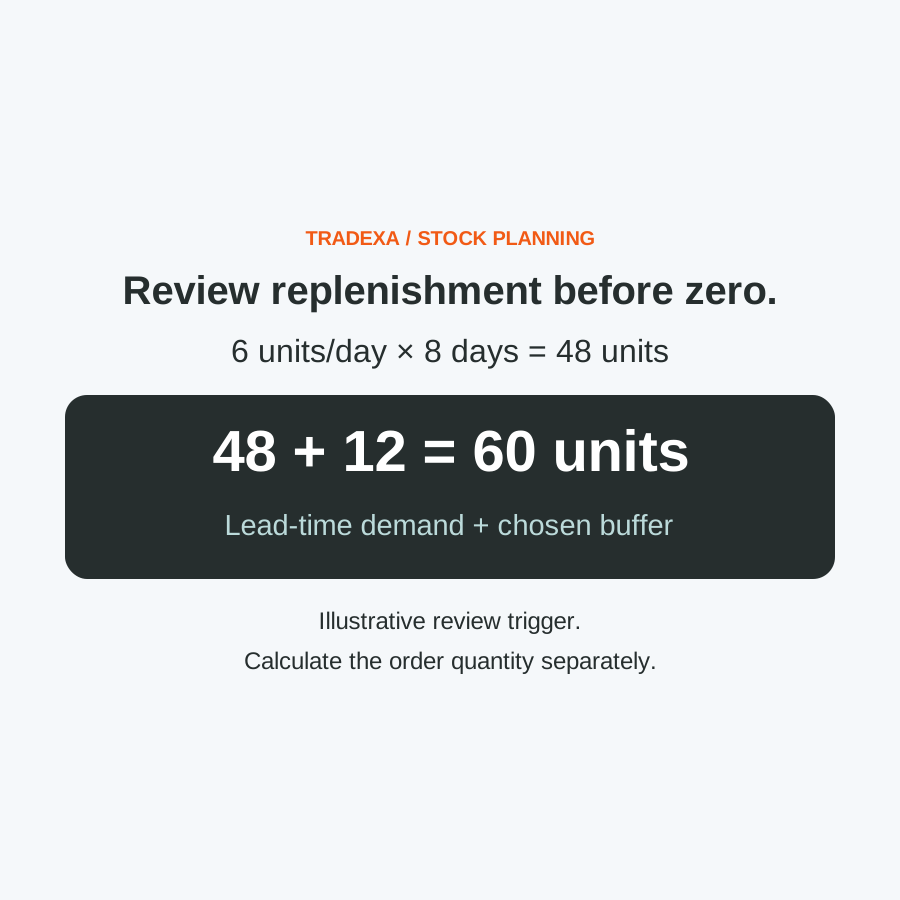
Consider an illustrative product with expected new demand of six units a day and an eight-day supplier lead time. Those eight days need 48 units. If you choose a 12-unit buffer, the planning trigger is 60 units: 48 for lead-time demand plus 12 for uncertainty.
The buffer is a chosen input, not a forecast-accuracy guarantee. Use your sales pattern, supplier reliability, stockout consequences and available cash to decide it. Promotional demand or a late supplier may require a different planning case from an ordinary week.
Lead time should cover the interval until goods can actually be used. Include relevant receiving and inspection time, rather than stopping the clock when a supplier says the parcel was shipped.
Include commitments and the stock already ordered
In the same scenario, suppose you have 45 saleable units, of which nine are committed to existing orders. That leaves 36 for new demand. A confirmed 20-unit receipt is due on day four, giving a planning position of 56 units before a new purchase.
The six units of expected daily demand here are for new orders; the nine existing commitments have been deducted separately. If your demand forecast already includes those commitments, do not subtract them again.
At 56 units, the item is below the 60-unit trigger, so review replenishment. Check the incoming delivery date as well as its quantity. A receipt due after you run out cannot protect the intervening days merely because it appears on an open purchase order.
Tradexa's HyperInventory brings connected stock and sales reports together with demand forecasts and overstocked or understocked signals across integrated channels. Use those views to identify products that need a buying review, then check supplier arrival dates, commitments and pack quantities before deciding the order. That gives purchasing a starting point grounded in both stock and demand, rather than the shelf quantity alone. This guide's calculation is a manual planning aid; it is not a claim about the platform's exact forecasting formula or an automatic purchase order.
Work out the quantity after deciding the coverage period
Suppose you choose a 13-day coverage horizon: the eight-day lead time plus five further days of demand. Thirteen days at six units a day is 78 units. Adding the chosen 12-unit buffer makes a 90-unit target position. Review the position as demand and receipts change; the coverage horizon is not an instruction to wait 13 days before checking again.
Against the 56-unit position already available or confirmed inbound, the uncovered quantity is 34 units. If the supplier sells only in packs of ten, the practical order becomes 40 units, subject to its minimum quantity and your cash decision.
At an illustrative purchase cost of ₹200 per unit, 40 units require ₹8,000 before any additional charges. Rounding is a buying decision with a cash effect; it is not evidence that all 40 units will sell as forecast.
Before approving that spend, check whether usable spare stock exists elsewhere. The separate transfer-or-buy comparison helps assess arrival time, sender commitments and handling cost without repeating the replenishment calculation.
Keep a replenishment decision record
Use this record for one product, then revisit it when demand or lead time changes.
- Product, unit and planning period: ______
- Expected new demand per day: ______; basis: ______
- Time until replenishment becomes usable: ______
- Chosen buffer and reason: ______
- Lead-time demand plus buffer trigger: ______
- Saleable on-hand quantity: ______; existing commitments: ______
- Confirmed incoming quantity and usable date: ______
- Planning position and any gap before receipt: ______
- Coverage target: ______; uncovered quantity: ______
- Supplier pack/minimum and proposed purchase quantity: ______
- Purchase cash and other applicable charges: ______
- Decision, owner and next review: ______
The output should be a buy, transfer, expedite, defer or investigate decision with its assumptions visible. If the expected receipt is uncertain, keep an alternative case rather than hiding that uncertainty inside the total stock figure.
Check whether the next receipt arrives before the gap
In the example, the 20 units due on day four arrive before the 36 available units would be exhausted by six units of daily new demand. If that delivery moves to day twelve, the same calculation no longer describes a protected eight-day period. Recheck the timeline and consider an earlier transfer or supply option.
This is why a stock position and an arrival plan belong together. A reassuring total can still conceal a day when the shelf is empty.
A clearer purchase decision may reduce emergency ordering and avoid adding another pack before an existing receipt is counted. Any cash kept available can support the next relevant stock line or a confirmed order, provided demand and supplier timing hold. The goal is reliable supply with an explained purchase, not minimum stock at any cost.
Example note: Demand, lead time, buffer, quantities and ₹200 cost are illustrative planning inputs, not measured customer results. Replace them with your commitments, actual receipts, supplier terms and demand assumptions.