The integration says “connected”. A customer still sees a product available after its last unit has sold elsewhere. Both observations can be true.
A working connection is not proof that every update is complete at the destination. Before depending on an integration, find out what moves, how long the movement takes and what the team does when it fails.
What does connected actually cover?
List the records your workflow needs: products, stock, orders, customers, invoices or payment-related entries. Then establish the direction for each. A connector may handle some records without handling all of them in both directions.
Also agree which system controls each value. If two teams independently change the same stock quantity in different systems, a successful update can still carry the wrong operational meaning.
This is why “does it integrate?” is an incomplete buying question. Ask whether it supports your required records and decisions.
How will you know an update reached the destination?
Use one identifiable product and one controlled test. Record the starting quantity, the change, its source time and the result visible at the destination.
Test more than an ordinary sale. Include a cancellation, a stock receipt and an item returned but not yet saleable where the supported workflow applies. Confirm what each event is supposed to change before testing it.
Keep expected timing separate from observed timing. One fast test does not establish peak-period performance or a service guarantee. Ask the provider about update frequency, failure visibility and recovery; do not assume that every connector uses the same mechanism.
What happens if the update is missing?
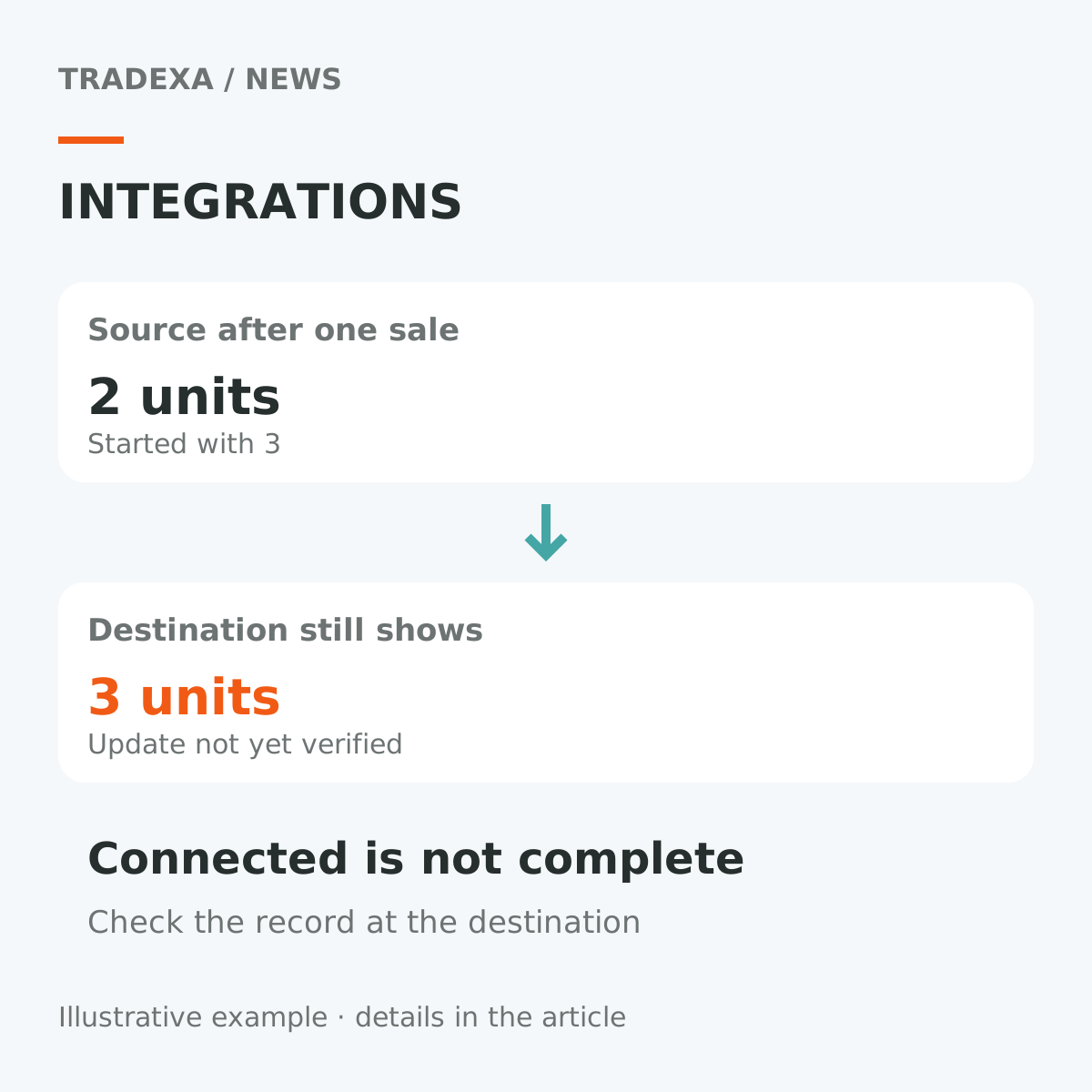
An illustrative test begins with three saleable units and a sale of one. The source now shows two, while the destination still shows three. The difference remains unresolved until the destination is checked—not until someone reports that an update was attempted.
Agree who investigates, what evidence they need and whether the integration can safely retry the operation. A repeated update must not create a duplicate transaction or overwrite a newer valid value.
Do not add manual edits casually. They can hide a failed update or create a second competing source. Record the intervention and reconcile the outcome.
What does this buy the operations team?
A clearer failure process replaces repeated “has it synced yet?” conversations with an identifiable record, owner and next check. That can mean fewer interruptions and less customer recovery work.
For example, investigating 40 unclear updates a week at ten minutes each uses 6 hours 40 minutes. If traceable records reduce investigation to four minutes, the same cases take 2 hours 40 minutes. Four hours a week become available, or 208 a year at the same case volume. No failures have been assumed eliminated.
HyperInventory has supported marketplace, webstore and accounting integrations with defined scopes. Tally, Busy and other supported connections should be evaluated for their own setup—not assumed to have identical behaviour.
Before relying on a new connection, ask for a workflow test, expected timing, failure evidence and a recovery owner. That turns a connection badge into an operational relationship your team can actually use.