The newer delivery has the earlier expiry date. Both batches sit on the same shelf. Which one should your picker take?
Use FIFO when receipt order is the appropriate stock-rotation rule; use FEFO when the earliest eligible expiry should determine what leaves first. First remove stock that cannot be sold or does not meet the customer's remaining-shelf-life requirement. A rotation rule chooses among eligible batches; it does not make an unsuitable batch safe to dispatch.
For an importer handling several brands, this distinction matters because two identical product codes can have different remaining selling windows. A single total quantity hides that decision.
Receipt order and expiry order can disagree
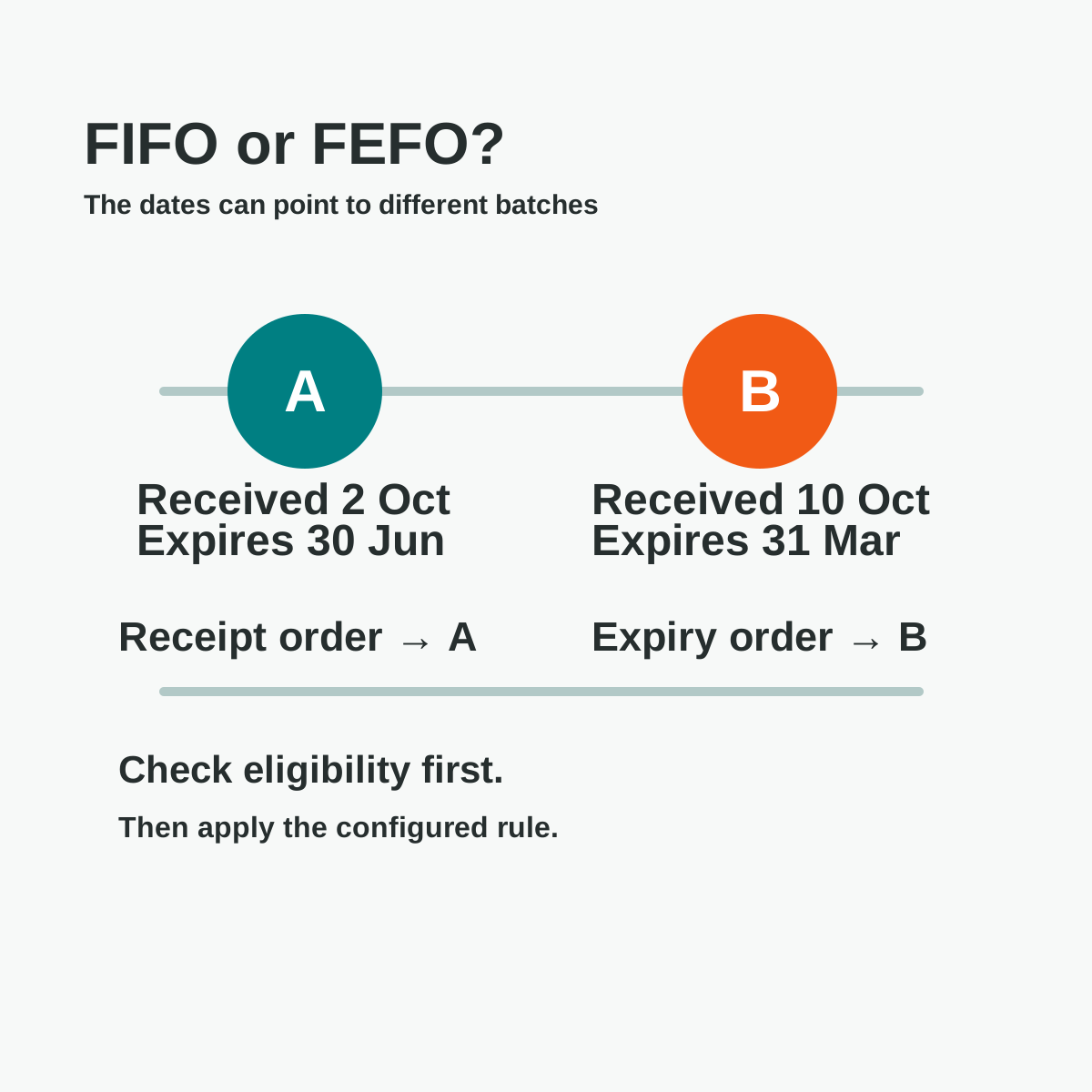
FIFO means first in, first out: the batch received earlier takes priority. FEFO means first expiry, first out: the batch with the earlier expiry takes priority. They produce the same answer only when receipt and expiry dates happen to run in the same order.
Suppose batch A arrived on 2 October and expires on 30 June next year. Batch B arrived on 10 October but expires on 31 March. Both contain the same product, and both pass the current condition and customer requirements. FIFO points to A; FEFO points to B.
WHO's procurement quality guidance describes FEFO stock rotation in its pharmaceutical context. The general lesson here is to use the relevant date deliberately. This article is an operational picking guide for ordinary commerce, not a claim of pharmaceutical suitability or regulatory compliance.
Decide which products need which rule
Start with one product family. Record whether expiry affects saleability, whether a dealer or retailer requires minimum remaining shelf life, and whether the batch dates are dependable. Do not assume that one brand's rule fits every product you import.
For a non-expiring accessory, receipt order may be a useful way to rotate older stock. For an expiry-controlled consumable, expiry order may matter more. Neither rule replaces checks for damage, recalls, blocked stock or a customer's specific terms.
If expiry is missing, stop and resolve it with the responsible team. Guessing a date to make the system select a batch defeats the purpose of recording it.
Test the rule on two batches
Copy this small test record before configuring the wider catalogue:
- Product and warehouse: one exact SKU and the stock location being tested.
- Batch A: receipt date, expiry date, eligible quantity and condition.
- Batch B: receipt date, expiry date, eligible quantity and condition.
- Customer requirement: minimum remaining shelf life at delivery, if applicable.
- Chosen rule and expected batch: write the answer before processing the test.
- Actual result: batch and quantity recorded on the invoice or shipment; reviewer and unresolved difference.
Use the two batches above with a test date of 20 October. First test a customer whose shelf-life terms allow either batch. Then test a customer whose documented requirement excludes B. FEFO should not be treated as permission to send B in that second case. Agree how eligibility checks and exceptions are handled in your implementation; do not assume a customer-specific rule exists merely because FEFO is available.
Repeat with an order larger than the first eligible batch. Check the quantities recorded across batches, not only the first batch name.
Make the recorded batch match the carton
HyperInventory tracks batches and expiry dates. The merchant can configure FIFO or FEFO so the system selects the batch automatically, and batch allocations are recorded against invoice or shipment lines.
That connection is useful only when the warehouse actually picks the recorded batch. Label the physical stock, keep receipt records accurate, and include a batch check in handover. A picker who takes a different carton must resolve the record before dispatch.
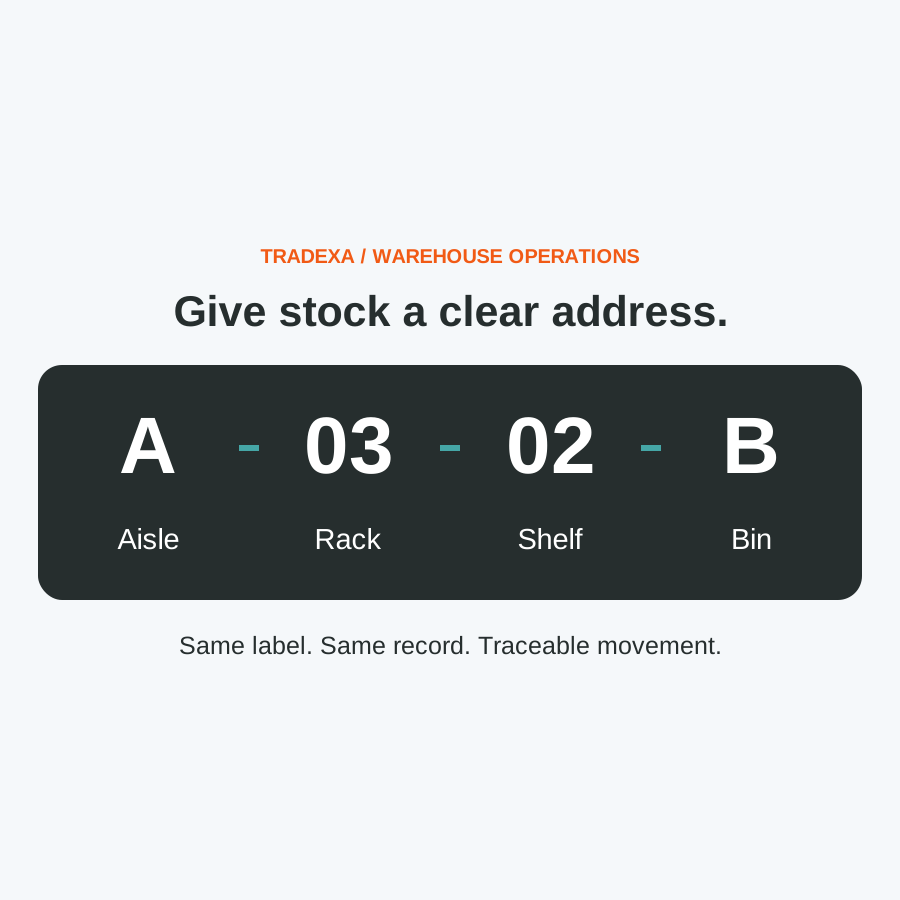
If staff spend time searching for the right location, the separate guide to naming warehouse racks and bins addresses that problem. Location and rotation are different checks.
Use the saved selling window
Picking the earlier eligible expiry first gives that batch more opportunity to sell while the later-expiring batch retains a longer window. The commercial value is avoiding an unnecessary expiry exposure, rather than increasing sales simply by changing a setting.
Review near-expiry quantities alongside actual demand. If more stock will expire than customers are likely to buy, a picking rule alone cannot solve it: purchasing, an appropriate promotion or another agreed action still needs an owner.
With a yearly Tradexa subscription, the professional team handles the agreed onboarding and trains your team. Use that training to demonstrate your real two-batch case. Post-sales support follows the plan and pre-sales agreement.
Sources
- WHO model quality assurance system for procurement agencies, stock rotation guidance; consulted 20 October 2026. Its pharmaceutical context is not a claim about HyperInventory's sector compliance.