“We want ₹3 lakh in sales next month” is a useful ambition. It is not yet an ad budget. First decide how much of that target you expect from existing customers or other non-ad routes, and how much you are asking advertising to support.
Build a starting budget from that ad-attributed sales target and a disclosed performance assumption. Then set a smaller test and a decision point. The estimate should make an uncertain plan visible, not turn the target into a promise.
Separate the total sales goal from the advertising part
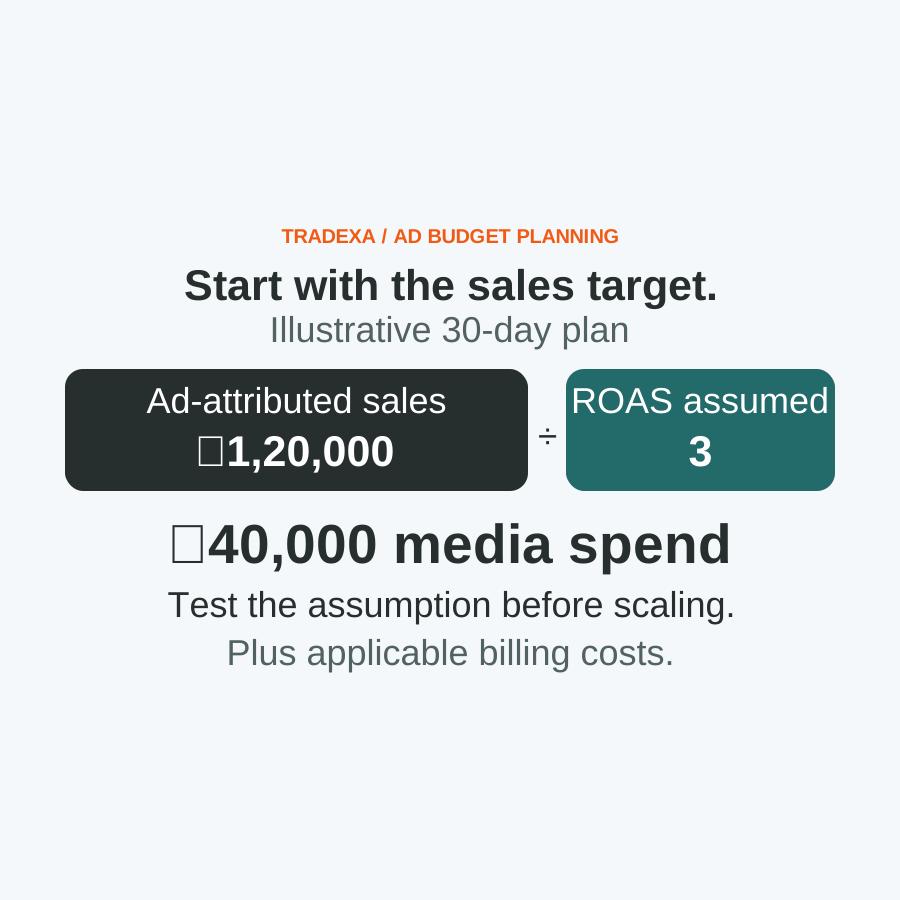
Consider an illustrative 30-day plan with a ₹3,00,000 total sales target. Suppose you expect ₹1,80,000 from non-ad routes and allocate ₹1,20,000 to sales attributed to advertising.
At an assumed ROAS of three, ₹1,20,000 divided by three gives a ₹40,000 media-spend estimate. At ROAS two, the same ad-attributed target needs ₹60,000; at ROAS four, it needs ₹30,000. These are planning cases, not evidence that a channel will achieve any of those returns.
Use a sales basis that you can compare with actual results, including a clear treatment of returns. The ₹1,80,000 non-ad estimate is also an assumption to test. An attribution report is not proof that advertising caused every reported sale, so do not add overlapping conversions from Amazon, Google and Meta as if they were separate customers.
Check whether that spend leaves enough room
A sales target does not establish how much the products can afford in advertising. Check contribution before ads, expected fulfilment costs and the cash you can commit to the test.
Use the separate guide to product margin before scaling ads for that affordability decision. This article's job is the target-to-budget plan; it does not replace the cost calculation with a revenue goal.
The ₹40,000 example is media spend, before any additional applicable billing taxes or fees. Finance should include those in the cash plan. Check that the advertised products have usable stock and that the team can fulfil the orders the plan expects.
Give the first test a smaller decision
Suppose you allocate ₹7,000 of the ₹40,000 media plan to the first seven days. If that test reports ₹21,000 of sales on the agreed basis, the observed ROAS is three. Review stock, returns, contribution and fulfilment before deciding what the remaining ₹33,000 should do.
If the test instead reports ₹14,000, its ROAS is two. At the same return, the original ₹40,000 media plan supports ₹80,000 in ad-attributed sales, leaving the assumed total at ₹2,60,000 rather than ₹3,00,000.
That does not automatically justify spending more. Check targeting, product fit, landing experience and measurement, then decide whether to revise the target, improve the test, reallocate spend or approve a larger budget. In this alternative case, reaching the remaining ₹1,06,000 ad-attributed target at ROAS two would need another ₹53,000, bringing media spend to ₹60,000 including the first ₹7,000. Make that extra cash decision explicit.
HyperAds can recommend a starting ad budget from your target sales number and suggest scale-up amounts. Its integrated product-level planning and monitoring spans Amazon, Google, Meta and Flipkart. Use those recommendations with your stock, margins and performance context; the simple worksheet here is not a description of the product's exact recommendation formula.
Write a budget decision record
Keep the assumptions beside the spend decision so the next review can explain what changed.
- Period and total sales target: ______
- Expected non-ad sales and basis: ______
- Ad-attributed sales target and measurement basis: ______
- Assumed ROAS cases and evidence: ______
- Estimated media spend for each case: ______
- Applicable additional billing costs and cash limit: ______
- Product contribution, stock and fulfilment checks: ______
- Initial test spend, period and review date: ______
- Actual spend, comparable sales and returns: ______
- Continue / improve / reallocate / stop decision: ______
- Any revised budget, approver and next check: ______
For a multi-channel plan, write down how reported conversions will be compared and how the total spending limit is tracked. A useful integrated view still needs an agreed sales basis and an owner for exceptions.
Turn the planning number into the right platform setting
A 30-day plan divided by 30 is an average pace, not a universal daily cap. Google explains that average daily budgets can vary in daily spending and operate with spending limits. Check the relevant budget type and limits for each platform rather than copying one daily number into every account.
A clear test decision helps keep cash available for the products and campaigns with a supported opportunity, instead of committing the whole month to an untested assumption. That can support more useful advertising work when measurement and product economics hold. It does not guarantee incremental sales or profit from a larger budget.
Example note: Sales allocations, ROAS values and test amounts are illustrative planning inputs, not measured customer results. Replace them with a consistent sales basis, your product economics, billing terms and observed performance.