The first branch can sign in. Products are visible. Someone has made a test order. Is that enough to move the next branch?
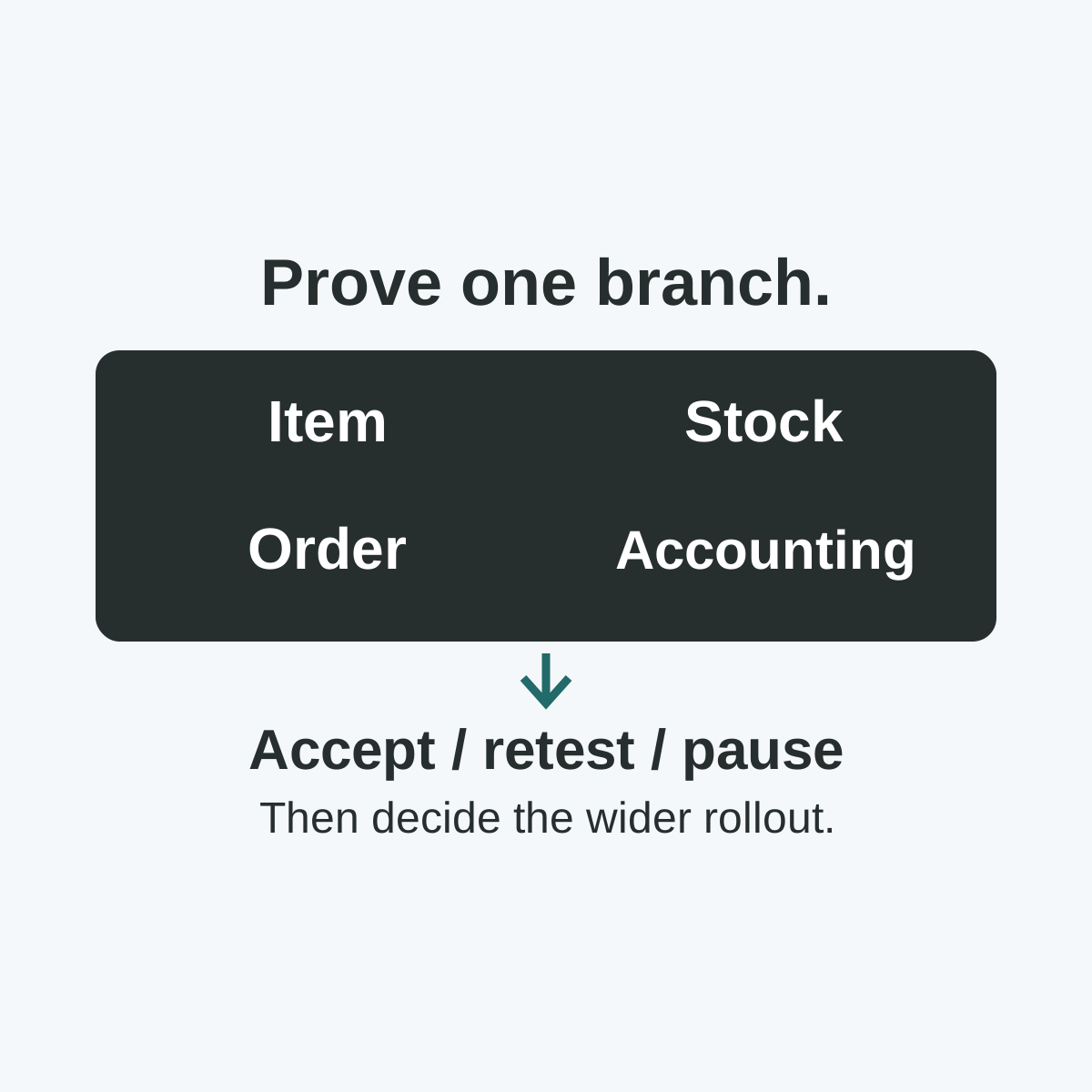
A useful pilot proves the handovers your business depends on: the intended item, the right stock, an order the warehouse can fulfil and the agreed accounting result. Define those acceptance checks before choosing a wider rollout date. A successful login is a start, not the rollout decision.
Pick a representative slice of the business
Choose one branch and a manageable set of real workflow types. Include the awkward cases that could change the decision: similar product variants, a dealer order, a website order where relevant, a shortage, a return through the supported path and an accounting exception.
Do not use only the easiest item and the head-office administrator. Include the people who will operate the branch, pick goods and check the books. Confirm their actual roles and visibility. A head-office user seeing every record does not demonstrate what a branch user will see.
Write down the pilot boundary: company, branch, warehouse, products, selling routes and accounting connection. An importer representing several brands is not automatically running several legal companies. Keep the tested company and access model explicit rather than assuming one branch pilot proves a multi-company setup.
Decide which record is authoritative
Agree where each real transaction is created and when the old process stops creating it. During rehearsals, use the designated test environment and supported test records. Copying a live invoice into two systems without an agreed accounting process can create a reconciliation problem rather than a useful comparison.
Keep the opening quantities and references needed to explain the pilot. Then follow the agreed posting events. For example, if a controlled stock case starts with twenty units, dispatches three and accepts one inspected return back into saleable stock, the expected ending quantity is eighteen: 20 − 3 + 1. Verify the configured documents and actual posting points; placing an order alone does not establish that physical stock has reduced.
If the physical and system quantities differ, resolve the cause before expanding that path. Do not hide an unexplained difference inside a fresh opening balance or assume a test upload proves every existing record migrated correctly.
Test the handover, including the exception
For a selected order, inspect the received product and unit, stock/reservation treatment, fulfilment record and the finance team's expected accounting handover. Compare the actual result with the accepted source data. Where an integration is involved, record its update timing and error handling.
Then deliberately exercise a supported exception in the test environment: an unmatched item, a short pick or a failed accounting handover. Identify who sees it, who corrects it and what evidence closes it. A pilot that only records successes cannot tell the next branch how to recover from a normal working-day problem.
HyperInventory connects supported catalogue, stock, orders, invoicing and shipments, with roles and branch-scoped operations. Its supported Tally, Zoho or BUSY connection must be the one actually included and configured in your implementation. Testing one connection does not establish identical behaviour in the other two.
Keep a branch-pilot acceptance record
Use one row or record for each tested workflow. Keep the evidence with the person deciding whether that path can expand.
- Company, branch, warehouse and selling route: ______
- Product/variant/unit and source data reference: ______
- Scenario and designated test environment: ______
- Expected item, quantity, documents and accounting result: ______
- Actual references, observed result and integration timing: ______
- User role and visibility checked: ______
- Exception tested, correction owner and closure evidence: ______
- Staff training or handover still required: ______
- Accept / correct and retest / exclude from this rollout: ______
- Wider rollout decision, responsible person and next review: ______
A discrepancy-free sample is evidence for the scenarios tested. Keep a separate list of products, routes and exceptions not yet covered. The next branch should inherit the accepted procedure and known limits rather than a general statement that “the pilot passed”.
Expand what passed, and keep ownership visible
With a yearly Tradexa subscription, the professional team handles onboarding, helps with migration, sets up the agreed products and integrations, and trains the owner and team without an additional training charge. That gives the pilot a practical setup and adoption partner; the merchant still supplies decisions, checks business records and owns acceptance. Post-sales support follows the selected plan and pre-sales agreement.
Ongoing catalogue management, order processing or other managed operations can be covered by a separate monthly service subscription within its agreed scope. They are not automatically part of yearly onboarding. The pilot should make clear which recurring tasks your staff will own and which are contracted services.
A tested handover can let the next branch reuse a working setup instead of repeating the same unresolved decisions. That may leave more implementation and operations attention for adding a selling route or supporting additional orders, provided the branch's actual workflow matches the accepted scope. It is not a fixed migration timetable or a guarantee that every branch will need identical work.
For the financial plan, see software-switching costs beyond the subscription. This article owns the evidence for the rollout decision. End the pilot with a clear accept, retest or pause decision—not just a calendar date.
Example note: The twenty-unit stock case is illustrative. Use authorised tests, actual posting rules and finance-approved transition procedures for your implementation.