Your dealer can sell a product they have not bought into their own warehouse. That is useful only if the sale leaves both businesses with the right records—and the supplier knows exactly where the parcel must go.
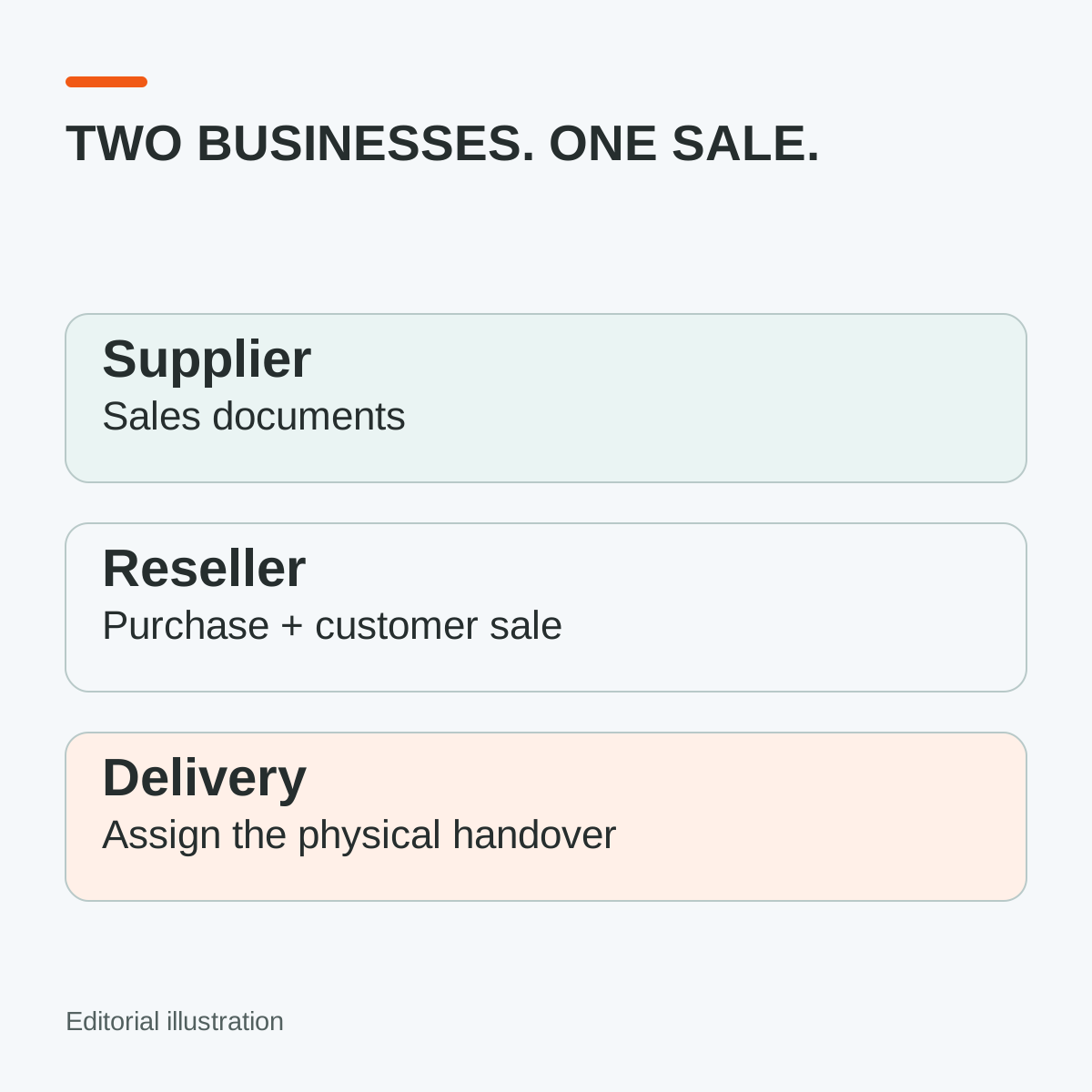
Tradexa's Direct Fulfilment supports that model: a separate reseller company sells the supplier's shared stock, and the configured sale generates linked commercial documents on both sides. The physical handover to the end customer still needs an assigned owner. Start by agreeing those two responsibilities rather than assuming that automated paperwork also books the courier.
Confirm whose business is making the sale
Direct Fulfilment links a supplier's DF Selling Warehouse with a reseller's DF Reselling Warehouse. The supplier's quantity is mirrored into the reseller's sellable availability; it is not a prior purchase or transfer of those goods into reseller-owned stock.
That is different from running distributors as branches of one company. The network-model guide explains that choice. Here, assume two separate companies have chosen Direct Fulfilment and need to accept one complete sale.
Each reseller may see the full shared quantity. It is not an exclusive stock allocation for that reseller, and simultaneous sales can create availability exposure before resynchronisation. Agree how availability exceptions will be resolved before making a firm customer commitment.
Follow the invoice-triggered document chain
Suppose a reseller sells one specialist lens from a supplier's linked stock. In the configured automatic-processing path, raising the reseller's customer invoice triggers the supplier-side cart, quotation, order, invoice and shipment record, together with a purchase bill on the reseller's side.
The connection is the important part: the supplier's sale to the reseller and the reseller's purchase can be recorded without re-entering the transaction into two separate businesses. The configured chain is atomic; if it fails, the originating reseller invoice is rolled back. Ask to see both the successful case and the failed case during acceptance testing.
Commercial configuration also matters. Settings affect whether the supplier bills using the reseller's sold price and how the sold-by/sold-through identity appears on the invoice PDF. Confirm the agreed parties and price basis; do not assume every reseller relationship uses the same treatment.
Do not confuse a document status with the parcel's journey
The generated supplier shipment is marked delivered as part of the commercial chain. That status does not prove that the end customer has received a parcel. In the supported workflow, the supplier shipment carries the reseller warehouse address, and the end-customer invoice/address and courier handover are handled separately by the teams.
Assign the reseller to pass the correct customer invoice and delivery details to the supplier. Assign the supplier to verify those details, prepare the parcel, arrange the courier and return the agreed dispatch evidence. Use a controlled process for customer data and restrict access to the people doing the fulfilment.
This boundary is practical, not a reason to miss the opportunity. The supplier can ship directly to the reseller's customer instead of sending the item through a reseller stocking location. What remains manual must be visible in the plan, including a wrong-address or failed-delivery exception.
Copy a Direct Fulfilment handover record
Complete this with the supplier and reseller before enabling the live workflow.
- Supplier and reseller companies, linked warehouse references: ______
- Item, quantity and latest availability check: ______
- Customer invoice and agreed sold-by/sold-through treatment: ______
- Supplier order/invoice and reseller purchase-bill references: ______
- Agreed price basis and document reconciliation result: ______
- End-customer address/invoice handover owner and secure route: ______
- Packing/courier owner and physical dispatch evidence: ______
- Delivery confirmation and exception owner: ______
- Failed-chain test and agreed recovery contact: ______
The output is an accepted sale-and-delivery responsibility map. If the documents agree but nobody owns the customer handover, the workflow is not ready for live orders.
Expand the range without pretending the work disappears
Direct Fulfilment can let a reseller offer a relevant specialist line without buying local stock first. The supported document connection reduces repeated transaction entry; the team can use that capacity to handle customer questions and fulfilment exceptions as the range grows.
Demand, availability and reliable supplier dispatch still determine whether the opportunity becomes completed sales. Each company retains its own books; this model does not create one consolidated report across independent companies. Ask for a demonstration of one successful sale, one failed document chain and one delivery exception before expanding the relationship.